Case Details
Protocol: WebRTC (Browser & Native)
Integration: Android SDK + REST API
Featured: Click-to-Call, Recording, Logs, Conference
Audience: Developers & Product Teams
Download Case Details
Download a detailed report on this case
Let’s Work Together for Development
Call us directly, submit a sample or email us!
Address Business
Call Us
+91 90566 66655
Working Time
Holiday : Closed
About the Client
The client is a software product company building a general-purpose communication infrastructure layer for other development teams. Recognising that voice calling is a frequent requirement across industries — customer support, healthcare, EdTech, fintech, and marketplaces — the client set out to build a reusable, plug-and-play calling service that any developer team could integrate without needing deep WebRTC expertise.
Rather than building a consumer-facing product, the goal was to create infrastructure: an SDK and REST API that abstract all the complexity of real-time voice communication, so product teams can add professional-grade calling to their applications in hours, not months.
Why We Were Approached
The Problem
| No Reusable Calling Infrastructure | Every product team that needed voice calling had to research, evaluate, and build their own calling stack from scratch — consuming months of engineering time before a single business feature could be shipped. |
| WebRTC Complexity | WebRTC is a powerful but notoriously complex protocol. Setting up signalling servers, STUN/TURN infrastructure, peer connection handling, codec negotiation, and NAT traversal requires deep specialist expertise that most product teams don't have in-house. |
| No Standard SDK for Android | Developers integrating calling into Android apps had no clean, documented SDK to drop in. Raw WebRTC libraries require significant boilerplate, are hard to test, and produce inconsistent behaviour across device manufacturers. |
| Recording & Compliance Gap | Businesses that required call recording for compliance, quality assurance, or dispute resolution had no ready-made solution — building this on top of a raw WebRTC stack requires additional media server infrastructure. |
| Observability & Analytics Missing | Without a built-in call logs and analytics layer, product teams could not monitor call quality, track durations, debug failed calls, or generate reports — essential for any production-grade calling feature. |
| Scaling Multi-Party Calls | Enabling conference or multi-party voice calls requires a selective forwarding unit (SFU) or MCU architecture that goes far beyond peer-to-peer WebRTC — a significant engineering challenge to build reliably at scale. |
The Solution
| WebRTC Engine | Handles peer connection lifecycle, codec negotiation, ICE gathering, and NAT traversal via STUN/TURN | |
| Node.js Signalling | Lightweight, event-driven signalling server managing session setup, offer/answer exchange, and room state | |
| Media Server (SFU) | Selective Forwarding Unit architecture enables scalable multi-party / conference calls without full media mixing | |
| REST API Layer | Clean, versioned REST endpoints for initiating calls, managing rooms, retrieving logs, and accessing recordings | |
| Android SDK | Drop-in Kotlin SDK abstracts all WebRTC complexity — developers call two methods to place or receive a call | |
| Analytics & Logs | Every call generates structured log events — duration, status, participants, quality metrics — queryable via API or dashboard | |
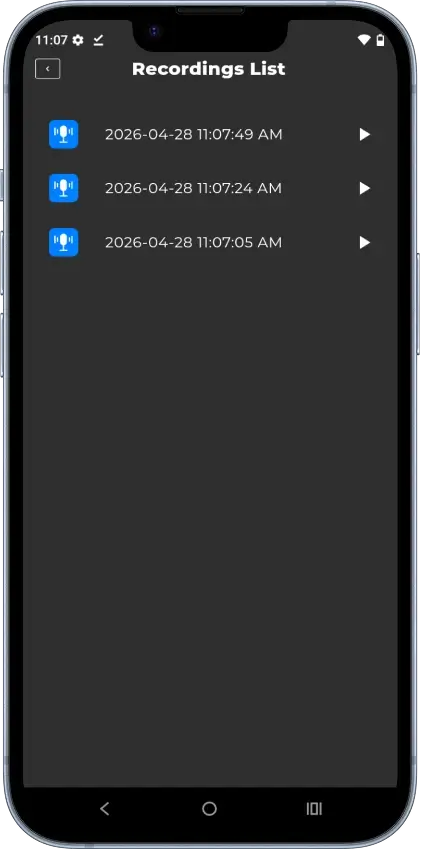
| Call Recording | Server-side recording pipeline captures, stores, and makes call recordings retrievable via secure API endpoint |
Features Delivered
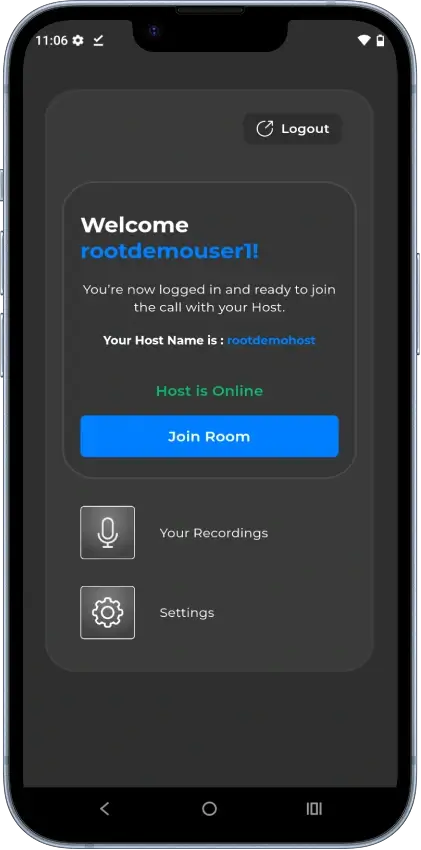
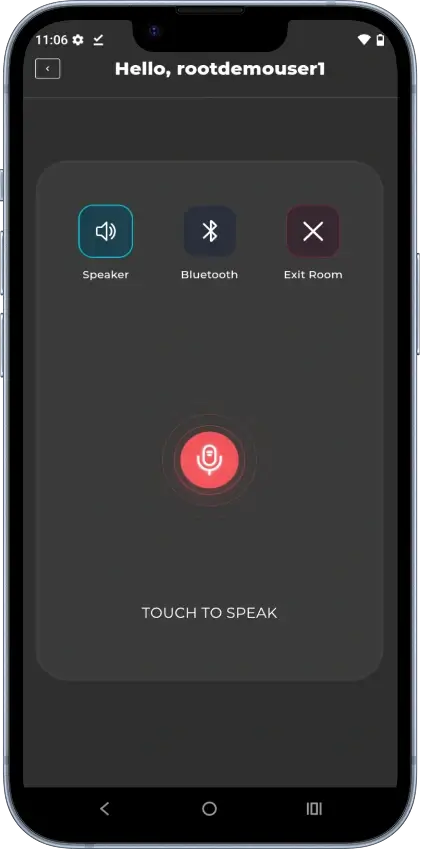
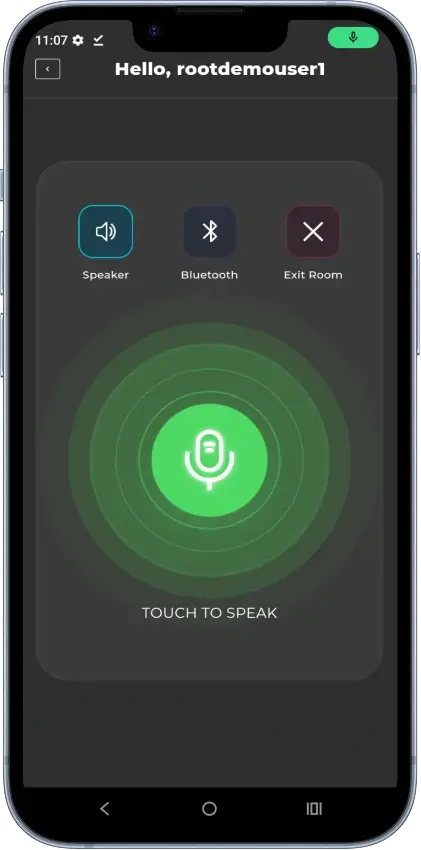
| Click-to-Call | A single API call or SDK method initiates a voice call between two parties — no manual dialling, no third-party app required. Designed for CRM systems, support desks, e-commerce platforms, or any product where instant calling is a workflow step. |
| Call Recording | Server-side recording is handled entirely by the infrastructure — no client-side complexity. Recordings are stored securely and accessible via a REST API endpoint, with configurable retention policies for compliance use cases. |
| Call Logs & Analytics Dashboard | Every call generates a structured event log — start time, end time, duration, status (answered/missed/failed), participant identifiers, and call quality metrics. Accessible via REST API for programmatic use or through a dashboard for non-technical stakeholders. |
| Multi-Party / Conference Calls | The SFU-based media architecture supports rooms with multiple simultaneous participants. Developers can create conference rooms, manage participants, and handle entry/exit events through straightforward API calls — no knowledge of SFU internals required. |
| Android SDK | A clean, documented Kotlin SDK packages the entire WebRTC stack. Developers initialise the SDK with API credentials and call standard methods to place calls, receive calls, manage call state, and handle events — the entire WebRTC complexity is invisible to the integrating developer. |
| REST API | All service capabilities are exposed as versioned REST endpoints, making the service language-agnostic and platform-independent. Any backend — regardless of tech stack — can initiate calls, retrieve recordings, query logs, or manage rooms with standard HTTP requests. |
The Results